How to Calculate Sealant Coverage & Yield
Master the formulas for calculating sealant volume, cartridge count, sausage foil yields, and waste allowances across rectangular and fillet joints.

Accurate sealant estimation is the cornerstone of profitable commercial contracting and structurally sound architectural engineering. Under-estimating joint sealant volume leads to emergency procurement delays, mismatched batch dye-lots, split shifts, and compromised curing intervals. Conversely, over-purchasing specialized elastomeric sealants—particularly high-performance neutral-cure silicones, hybrid silane-terminated polymers (STPE), and multi-component polyurethanes—traps working capital in perishable inventory with finite shelf lives (typically 9 to 12 months).
Whether you are calculating linear meter yields for an 80-story unitized curtain wall or budgeting cartridges for a commercial tile installation, sealant consumption follows immutable principles of Euclidean solid geometry, fluid dynamics, and packaging volumetrics.
In this exhaustive technical guide, we break down the exact mathematical formulas for all primary joint geometries, analyze packaging yields across standard industrial formats, detail field waste factors, walk through three complete engineering case studies, and explore nozzle orifice dynamics.
1. The Fundamental Volumetric Equation of Joint Sealing
Every joint sealant calculation begins with solid geometry: the volume of a three-dimensional extruded prismatic profile equals the cross-sectional area (A) multiplied by the total linear length (L).
V = A × LWhere:
Vis total sealant volume required.Ais the cross-sectional area of the joint cavity.Lis the continuous linear distance to be sealed.
+-------------------------------------------------------------+
|               THE METRIC VOLUMETRIC SHORTCUT                |
|                                                             |
|   Because 1 cubic centimeter (cm³) = exactly 1 milliliter   |
|   (mL), a joint cross-section of 1 mm² extruded along       |
|   1 linear meter yields exactly 1 mL of fluid sealant:      |
|                                                             |
|           Volume (mL) = Area (mm²) × Length (m)             |
|                                                             |
|   This elegant identity eliminates complex decimal math on  |
|   commercial job sites worldwide.                           |
+-------------------------------------------------------------+
Imperial vs. Metric Conversions
When operating in Imperial units (inches, feet, and fluid ounces), volumetric calculations involve non-decimal fluid volume conversions. The cross-sectional area is measured in square inches (in^2), linear length in linear feet (ft), and fluid volume in fluid ounces (fl oz) or gallons:
V_cubic inches = A_in^2 × (L_linear feet × 12)To convert cubic inches into US fluid ounces:
V_fl oz = \frac{V_cubic inches}{1.80469}To convert cubic inches into standard 10.1 fl oz cartridges:
Cartridges = \frac{V_cubic inches}{18.227}2. Joint Geometries: Rectangular vs. Triangular Fillet
The single most frequent estimation error in architectural specifications is calculating all sealant seams as simple rectangular boxes. Real-world construction assemblies contain two fundamentally distinct joint geometries: Rectangular Butt/Expansion Joints and Triangular Fillet/Corner Joints.
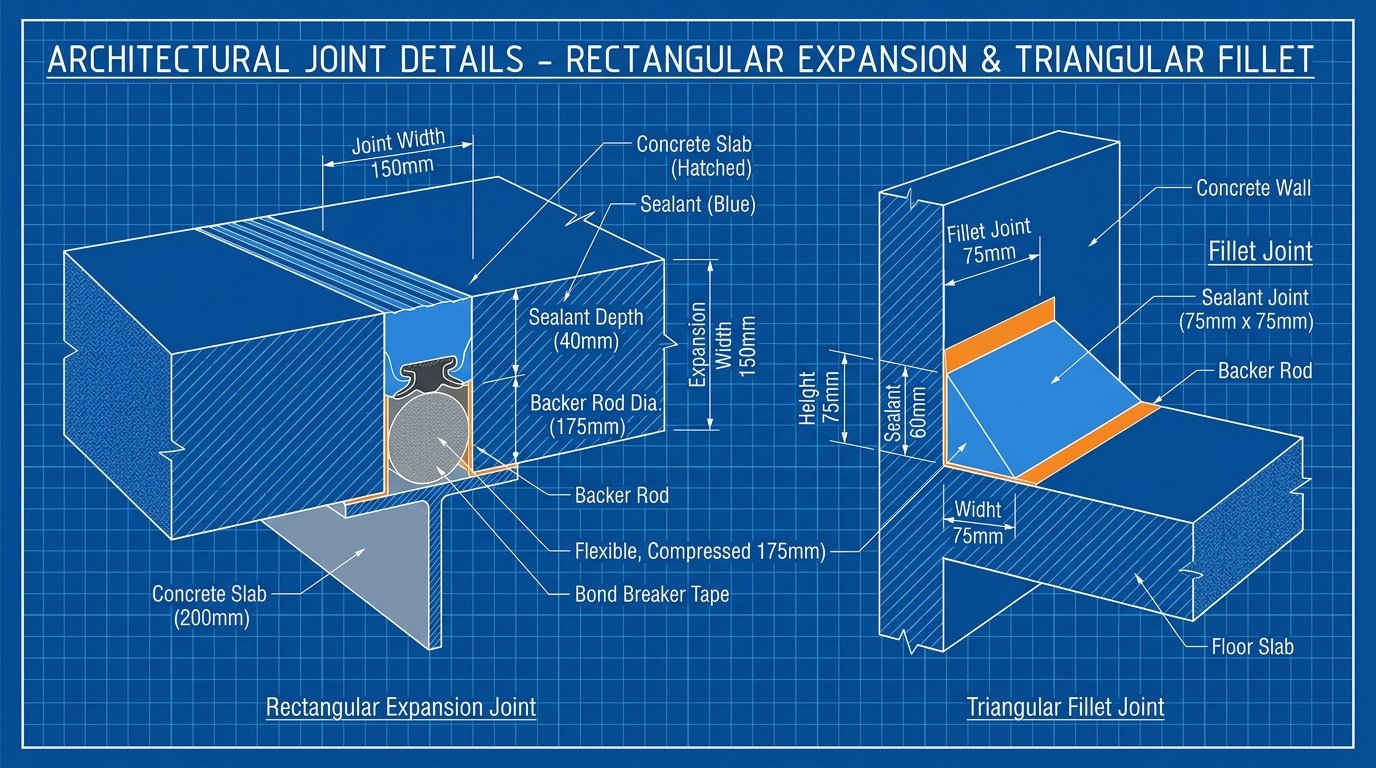
Figure 1: Cross-sectional profiles of a rectangular expansion joint with backer rod (left) versus a 90-degree triangular fillet perimeter joint (right).
A. Rectangular Expansion & Butt Joints
Rectangular joints occur between precast concrete wall panels, brick expansion seams, floor slab control saw-cuts, and curtain wall transom junctions. The theoretical cross-sectional area is:
A_rect = W × DWhere:
W= Joint Width (distance between opposing substrate faces).D= Sealant Depth (dimension measured from the tooled surface to the crown of the backer rod).
The Parabolic Concave Tooling Factor
In professional installations compliant with ASTM C1193 (Standard Guide for Use of Joint Sealants), the sealant is never tooled dead-flat. Applicators dry-tool the bead against a round backer rod, creating an hourglass profile with a concave outer face and a convex inner face.
This concave tooling reduces the true cross-sectional area by roughly 10% to 15% compared to a raw rectangular prism. However, structural engineers universally recommend calculating at 100% of the nominal rectangular area (W × D) without discounting for concavity. This theoretical “over-estimate” acts as a built-in safety buffer that offsets localized substrate width variations and minor concrete spalling along the joint shoulders.
B. Triangular Fillet Beads (90° Interior Corners)
Triangular fillets are specified where two surfaces meet at a right angle without an expandable gap between them. Examples include window perimeter perimeters, door bucks, shower wall-to-tray interfaces, baseboard perimeters, and countertop backsplashes.
Because a 90-degree corner forms a right triangle, the cross-sectional area is exactly half of the bounding rectangle:
A_fillet = (1 / 2) × Base × Height = 0.5 × W × HFor an equilateral 8 mm × 8 mm corner bead:
A_fillet = 0.5 × 8 × 8 = 32 mm^2[!WARNING] The 100% Fillet Estimation Mistake: If an estimator calculates an
8 mm × 8 mmperimeter fillet using the rectangular formula (8 × 8 = 64 mm^2), they will calculate double the actual required material. On a 2,000-meter commercial tower window perimeter project, this error wastes thousands of dollars in unnecessary cartridge purchases. Use our specialized Triangular Fillet Calculator to prevent costly over-budgeting.
3. Commercial Packaging Formats & Yield Benchmarks
Industrial sealants are distributed in standardized packaging designed for hand-held, pneumatic, or cordless electric dispensing guns. Knowing the exact net volume of each container type is critical for procurement.
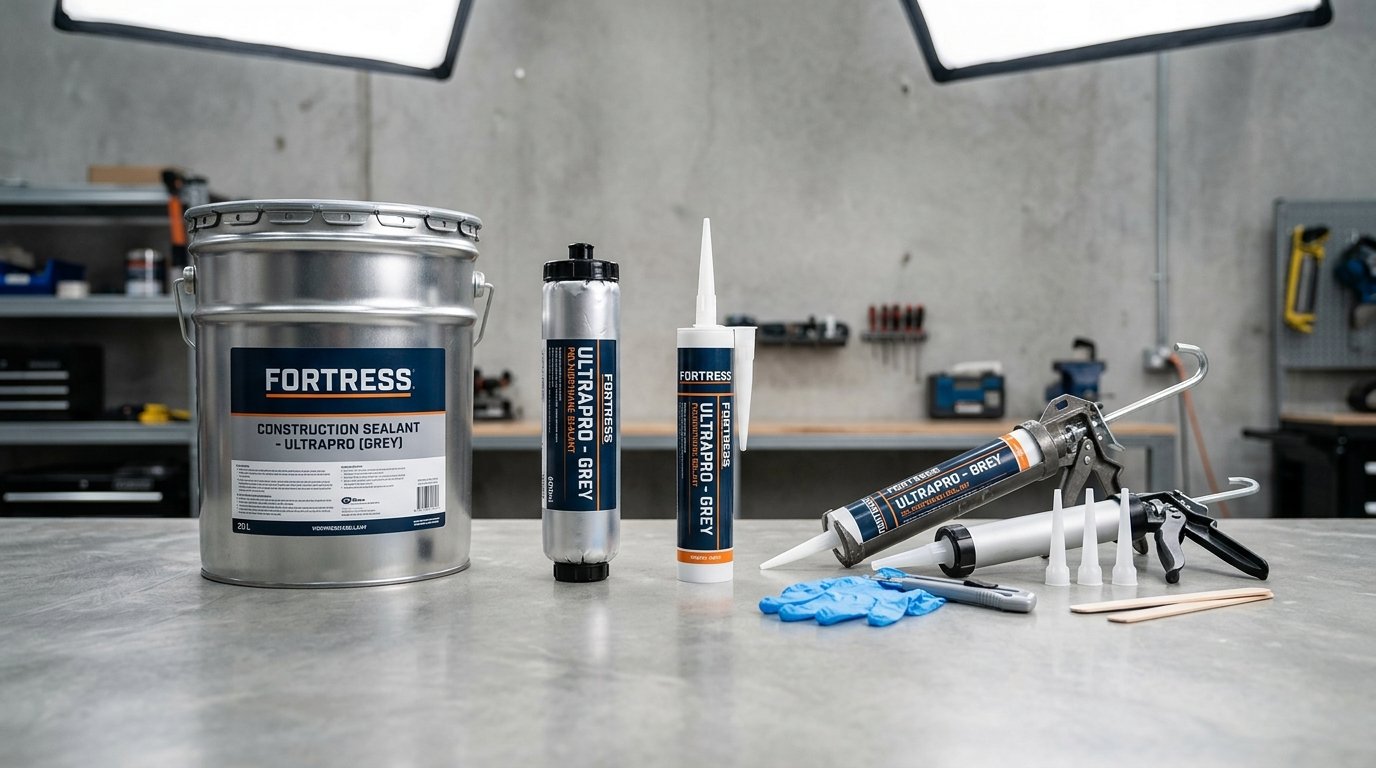
Figure 2: Primary commercial sealant delivery packaging: 20-liter bulk pail (left), 600 mL foil sausage pack (center), and standard 300 mL rigid plastic cartridge (right).
Common Industrial Delivery Formats
- Standard 10.1 fl oz / 300–310 mL Rigid Cartridges:
- The universal format for residential construction, architectural glazing, and sanitary trades.
- Nominal net fill varies between manufacturers from 290 mL, 300 mL, to 310 mL. Always verify the net volume listed on the technical data sheet.
- 20 fl oz / 600 mL Foil Sausage Packs (“Chubs”):
- The commercial standard for facade weatherproofing, exterior precast concrete, and high-volume perimeter sealing.
- Foil sausages generate 95% less landfill packaging waste than rigid plastic tubes and cost approximately 20% to 30% less per liter of sealant.
- 4.5 to 5 Gallon (17 to 20 Liter) Bulk Pails:
- Designed for heavy industrial flooring, airport runway joint sealing, and warehouse joint filling.
- Dispensed via follower-plate bulk caulking guns or continuous pneumatic pump rigs.
Theoretical Yield Matrix (Zero Waste)
The following reference matrix shows theoretical linear meter yields per packaging format across common architectural joint dimensions.
| Joint Width × Depth | Area (mm²) | Yield per 310 mL Tube | Yield per 600 mL Sausage | Yield per 20 L Pail |
|---|---|---|---|---|
| 6 mm × 6 mm (Butt) | 36 mm² | 8.61 m (28.2 ft) | 16.67 m (54.7 ft) | 555.5 m (1,822 ft) |
| 8 mm × 8 mm (Fillet) | 32 mm² | 9.69 m (31.8 ft) | 18.75 m (61.5 ft) | 625.0 m (2,050 ft) |
| 10 mm × 6 mm (Butt) | 60 mm² | 5.17 m (17.0 ft) | 10.00 m (32.8 ft) | 333.3 m (1,093 ft) |
| 12 mm × 6 mm (2:1 Ratio) | 72 mm² | 4.31 m (14.1 ft) | 8.33 m (27.3 ft) | 277.8 m (911 ft) |
| 15 mm × 8 mm (Butt) | 120 mm² | 2.58 m (8.5 ft) | 5.00 m (16.4 ft) | 166.7 m (547 ft) |
| 20 mm × 10 mm (2:1 Ratio) | 200 mm² | 1.55 m (5.1 ft) | 3.00 m (9.8 ft) | 100.0 m (328 ft) |
| 25 mm × 12 mm (2:1 Ratio) | 300 mm² | 1.03 m (3.4 ft) | 2.00 m (6.6 ft) | 66.7 m (219 ft) |
| 30 mm × 15 mm (Heavy Joint) | 450 mm² | 0.69 m (2.3 ft) | 1.33 m (4.4 ft) | 44.4 m (146 ft) |
4. The Engineering Waste Allowance Matrix
Theoretical yields assume factory-perfect dimensional tolerances, perfectly smooth substrate surfaces, and zero discarded paste. In real-world construction, material loss is inevitable.
To calculate real-world procurement requirements, apply an Application Waste Multiplier (W_m):
Total Units = ( \frac{V_theoretical}{Unit Volume} ) × (1 + W_m)Where W_m is determined by four practical field factors:
A. The 4 Components of Sealant Waste
- Packaging Heel Loss (2%–5%): Viscous polyurethane and silicone pastes adhere to cartridge walls and sausage foil skins. No manual gun piston can evacuate 100% of material from the container.
- Nozzle Purging & Bead Trim (2%–4%): Opening new cartridges, clearing skin-overs, and test-dispensing beads to check flow rates and angle cuts.
- Tooling & Scraping Losses (5%–15%): High-performance joint tooling involves driving the paste firmly into substrate pores with a radiused spatula, leaving scraped excess on masking tape or disposal boards.
- Substrate Texture & Width Variance (3%–10%): Poured-in-place concrete forms deviate. A nominal
20 mmexpansion joint will frequently measure23 mmin cold morning hours or flare outward due to form chatter, consuming significantly more volume than architectural drawings indicate.
| Substrate & Application Type | Recommended Waste Factor | Primary Risk Factor |
|---|---|---|
| Factory Curtain Wall / Clean Metal | 5% – 8% | Minimal substrate porosity; tight CNC mill tolerances. |
| Precast Concrete Panel Facade | 10% – 12% | Joint width creep across vertical building elevations. |
| Masonry, Brick & Sandstone | 15% – 18% | High capillary absorption, rough mortar joint transitions. |
| Rough Saw-Cut Pavement / Slabs | 18% – 25% | Shoulder spalling, inconsistent saw blade tracking. |
| Complex Overheads / Inexperienced Labor | 20% – 30% | Gravitational slump, excessive scrapage during tooling. |
5. Three Real-World Worked Engineering Case Studies
To see how these principles combine in practice, let us examine three detailed scenarios typical of modern commercial, sanitary, and industrial construction.
Case Study 1: Commercial Precast Concrete Facade
- Project Scope: Multi-story office park exterior facade sealing.
- Total Joint Run:
1,250 linear meters. - Nominal Joint Dimensions:
20 mm width × 10 mm depth(compliant with 2:1 ratio). - Specified Product: One-part low-modulus polyurethane sealant in
600 mLfoil sausage packs. - Substrate Condition: Precast architectural concrete with sandblasted finish (Waste factor:
12\%).
Step-by-Step Calculation:
- Calculate Joint Cross-Sectional Area:
A = 20 mm × 10 mm = 200 mm^2- Calculate Theoretical Volume Required:
V_theo = 200 mm^2 × 1,250 m = 250,000 mL = 250 Liters- Apply 12% Application Allowance:
V_actual = 250,000 mL × 1.12 = 280,000 mL- Determine 600 mL Sausage Packaging Count:
Sausages = (280,000 mL / 600 mL) = 466.67 ➔ 467 Sausages- Determine Carton Requirement: Commercial sausages are packed 20 per case:
Cartons = (467 / 20) = 23.35 ➔ 24 Full Cartons (480 Sausages)The procurement order should specify 24 cartons (480 sausages), providing an operational contingency of 13 sausages for touch-ups.
Case Study 2: Hospital Sanitized Shower & Restroom Complex
- Project Scope: Sanitary silicone perimeter fillet beads along tile-to-acrylic shower pans and tile-to-counter junctions.
- Total Fillet Run:
450 linear meters. - Nominal Fillet Dimensions:
6 mm base × 6 mm height(90^°right triangle). - Specified Product: High-grade sanitary acetoxy-cure silicone in standard
310 mLrigid cartridges. - Substrate Condition: Smooth glazed porcelain tile and acrylic pans (Waste factor:
10\%).
Step-by-Step Calculation:
- Calculate Triangular Fillet Area:
A = 0.5 × 6 mm × 6 mm = 18 mm^2- Calculate Theoretical Volume Required:
V_theo = 18 mm^2 × 450 m = 8,100 mL- Apply 10% Waste Factor:
V_actual = 8,100 mL × 1.10 = 8,910 mL- Determine Cartridge Count:
Cartridges = (8,910 mL / 310 mL) = 28.74 ➔ 29 Cartridges- Carton Optimization: Cartridges ship 12 or 24 per case. Ordering 3 cases of 12 (36 cartridges) ensures single-batch color consistency across all hospital restrooms.
Case Study 3: Industrial Distribution Center Floor Sawn Control Joints
- Project Scope: Heavy-duty logistics warehouse floor saw-cut joints to protect concrete edges against hard polyurethane forklift wheels.
- Total Sawn Joint Run:
4,200 linear meters. - Nominal Joint Dimensions:
5 mm width × 35 mm depth(full saw-cut depth filling for load transfer). - Specified Product: Two-component semi-rigid polyurea joint filler supplied in
10 Gallon (37.85 L)dual-drum bulk sets. - Substrate Condition: Diamond saw-cut slab edges with over-fill shaving allowance (Waste factor:
20\%).
Step-by-Step Calculation:
- Calculate Cross-Sectional Area:
A = 5 mm × 35 mm = 175 mm^2- Calculate Theoretical Volume:
V_theo = 175 mm^2 × 4,200 m = 735,000 mL = 735 Liters- Apply 20% Overfill/Shaving Factor: Industrial floor polyurea must be overfilled above the slab crown and shaved flush with a razor scraper after 60 minutes.
V_actual = 735 Liters × 1.20 = 882 Liters- Convert to Bulk Gallon Units:
Since 1 US Gallon
≈ 3.78541 Liters:
Gallons Required = (882 / 3.78541) = 232.99 Gallons- Determine 10-Gallon Dual-Drum Sets:
Sets = (233 / 10) = 23.3 ➔ 24 Sets (240 Gallons / 908 Liters)6. Nozzle Orifice Physics & Extrusion Geometry
Achieving exact yield and minimizing tooling waste depends heavily on how the applicator cuts the plastic dispensing nozzle.
                    NOZZLE CUTTING GEOMETRY

       45° ANGLE CUT                   STRAIGHT 90° CUT
    (Fillet & Corner Beads)         (Expansion Butt Joints)
            _______                         _______
           /      /                        |       |
          /  45° /                         |  90°  |
         /      /                          |       |
        /______/                           |_______|
           ▲                                   ▲
           │                                   │
Forces sealant against 2 faces.    Allows nozzle to penetrate
Smoothes bead automatically.       into cavity, filling from bottom.
The 45° Angle Cut vs. Straight 90° Cut
- The 45-Degree Angle Cut: Essential for triangular fillet joints. Cutting the nozzle at 45 degrees creates an elliptical aperture that forces sealant symmetrically against both intersecting planes while simultaneously tooling the diagonal face as the gun moves forward.
- The Straight 90-Degree Cut: Essential for deep rectangular expansion joints. A straight nozzle tip penetrates deep into the joint channel directly above the backer rod, preventing trapped air pockets beneath the bead.
Sizing the Orifice Diameter
The nozzle aperture opening should equal the exact width of the joint or approximately 1 mm narrower.
- If the nozzle is cut too small, excessive trigger pressure is required, introducing dispensing fatigue and inconsistent bead cross-sections.
- If the nozzle is cut wider than the joint, excess paste overflows the joint shoulders, doubling scraping waste and leaving unsightly stains on adjacent architectural masonry.
7. Frequently Asked Questions (FAQ)
How many linear feet can I get from one 10.1 fl oz tube of caulk?
For a standard 1/4 in × 1/4 in (6.35 mm × 6.35 mm) rectangular bead, one standard 10.1 fl oz (298 mL) cartridge yields approximately 24 to 26 linear feet under realistic job site conditions with a 10% waste allowance. For a 1/2 in × 1/4 in joint, yield drops to approximately 12 to 13 linear feet.
What is the difference between net fluid volume and weight on sealant cartridges?
Sealants are sold by fluid volume (milliliters or fluid ounces) because joint estimation is volumetric. However, different chemistries possess dramatically different specific gravities (densities). A 300 mL tube of pure silicone weighs roughly 310 grams (density ≈ 1.03 g/cm^3), whereas a 300 mL tube of heavy filled acrylic or polyurethane can weigh up to 450 grams (density ≈ 1.45 g/cm^3). Always use fluid volume (V) rather than package weight when calculating joint coverage.
Why do manufacturers package commercial sealants in 600 mL sausages instead of cartridges?
600 mL foil sausage packs offer three major engineering and commercial benefits:
- Packaging Volume: A sausage holds double the volume of a standard cartridge, halving the reloading frequency for applicators on high-scaffolding rigs.
- Environmental Waste: Once spent, the aluminum foil collapses into a tiny 5-gram disc, reducing solid plastic container waste by 95%.
- Cost Efficiency: Bulk foil packaging reduces packaging manufacturing overhead, saving contractors 20% to 30% per liter.
Does concave tooling reduce the amount of sealant I need to purchase?
Yes, concave tooling removes between 10% and 15% of theoretical rectangular joint volume. However, estimators should not subtract this from their procurement order. Instead, use this mathematical difference as a built-in safety allowance to accommodate job site width variations, concrete spalling, and nozzle heel loss.
Can I use the same formula for multi-component sealants mixed in pails?
Yes. Multi-component chemically-curing polyurethanes and polysulfides mixed with an electric paddle in 1.5 to 3-gallon pails obey the identical volumetric formula (V = A × L). However, remember that once mixed, chemical curing begins immediately. Factor in a slightly higher waste allowance (15% to 20%) to account for pot-life expiration and residual paste adhering to the pail sides and follower plate.
Interactive Calculation Tools
Stop calculating complex joint geometry by hand on the job site. Use our suite of specialized, instant calculators engineered to ASTM C1193 standards:
- Main Sealant Coverage & Cartridge Calculator — Instant yields for butt, expansion, and fillet joints.
- Bathroom & Corner Fillet Calculator — Precise right-angle corner and fixture estimation.
- Sealant Coverage & Yield Estimator — Compare yields between cartridges, foil sausages, and bulk pails.